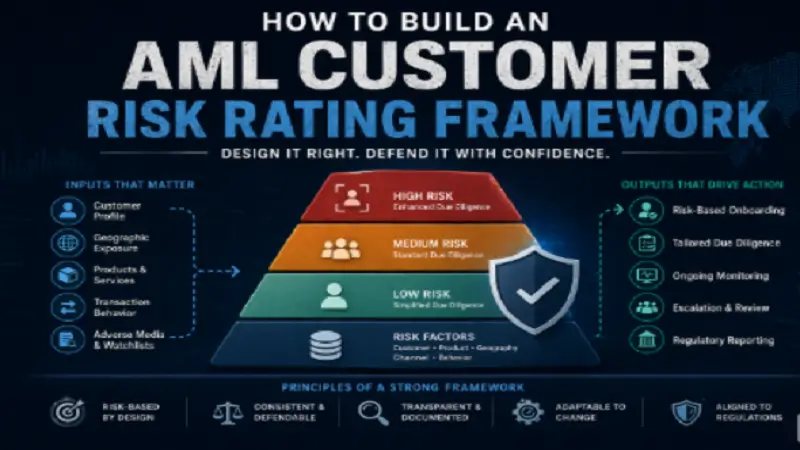
Most financial institutions have a customer risk rating framework. Far fewer have one that works the way regulators expect, produces scores that reflect actual risk, and updates meaningfully as customer behavior changes over time.
The gap between the two is where enforcement actions live. When regulators review an institution’s AML program, the customer risk rating framework is one of the first things they examine, and one of the most common sources of findings. Not because institutions lack a framework, but because the framework they have is poorly designed, poorly calibrated, or poorly maintained.
Building a framework that holds up requires clarity on three things: which risk factors to include, how to weigh them against each other, and what governance process keeps the model accurate over time. Each of those is harder than it looks on paper.
What a Customer Risk Rating Framework Is Actually Supposed to Do
A customer risk rating framework assigns each customer a risk tier, typically low, medium, or high, based on a structured assessment of how likely that customer is to be involved in money laundering, fraud, or other financial crime. That tier then drives compliance decisions: how much due diligence to conduct at onboarding, how frequently to review the customer’s profile, and how tightly to calibrate transaction monitoring for that account.
The risk-based approach, which FATF recommendations and most national AML frameworks require, depends entirely on this tier being accurate. When it is not, everything downstream is miscalibrated. High-risk customers placed in the medium tier receive insufficient monitoring coverage. Low-risk customers are incorrectly rated as high-risk consumers disproportionate analyst time. The entire efficiency case for risk-based compliance falls apart.
The goal of a well-designed framework is not just to categorize customers. It is to produce ratings that are defensible, consistent across the analyst team, and accurate enough to drive resource allocation decisions that a regulator could examine and find reasonable.
Why Most Frameworks Break Down in Practice
The most common failure mode is a framework that looks comprehensive on paper but collapses under operational pressure. This typically happens in one of three ways.
Over-reliance on inherent risk factors at onboarding. Many frameworks are designed primarily around the information collected during customer due diligence: nationality, country of residence, business type, industry sector, and source of funds. These factors are genuinely useful. They are also largely static. A customer’s country of incorporation does not tell you what they have been doing with their account for the past eight months.
Frameworks that weigh inherent factors heavily and give limited weight to behavioral signals will systematically miss the risk that develops after onboarding. This is not a hypothetical concern. The FATF’s guidance on risk-based supervision specifically identifies the failure to update customer risk profiles based on ongoing transaction behavior as one of the most common weaknesses in institutional AML programs.
Vague factor definitions that produce inconsistent ratings. When a framework defines risk factors in terms that require subjective interpretation, different analysts applying the same framework to the same customer will often reach different risk tier conclusions. “Complex ownership structure” means something different to each analyst applying it. “High-risk business type” depends on which list of business types the institution considers high-risk and whether that list is documented and consistently applied.
Vague definitions do not just create inconsistency. They create regulatory exposure. When an examiner asks why a particular customer was rated medium rather than high, the institution needs to be able to give a specific, documented answer based on the framework’s criteria. “The analyst used their judgment” is not a satisfactory answer.
No process for updating ratings as behavior changes. A framework that produces an accurate rating at onboarding but has no mechanism for updating that rating when behavioral signals shift is a static model wearing dynamic clothing. The rating reflects a point in time, not an ongoing assessment. As discussed in depth in Flagright’s breakdown of dynamic risk scoring algorithms for AML and fraud, the methodology used to update scores over time matters as much as the initial scoring design. Simple averages, rolling windows, and weighted behavioral models each behave differently under real transaction data, and choosing the wrong approach for a given risk factor leads to scores that lag, overcorrect, or lose historical context at the wrong moment.
This is also where legacy compliance platforms tend to expose their limitations most visibly. Systems built around rigid, batch-processing architectures were not designed to recalculate risk scores in real time as behavioral data arrives. Institutions running these platforms find themselves maintaining manual override processes and spreadsheet-based workarounds that introduce exactly the inconsistency and documentation gaps that regulators flag.
Which Risk Factors Should a Framework Actually Include?
There is no universally correct list of risk factors. The right set depends on the institution’s business model, customer base, product offering, and geographic footprint. A neobank serving retail customers in Western Europe faces a different risk landscape than a payment processor handling cross-border business transactions across Southeast Asia.
That said, well-designed frameworks consistently include risk factors drawn from three categories.
Inherent Customer Risk Factors
These are attributes that describe who the customer is, independent of what they do with their account. They include:
- Geographic risk: country of residence, nationality, and country of business incorporation, assessed against FATF grey and black lists, national high-risk jurisdiction designations, and the institution’s own geographic risk assessment.
- Customer type: individual retail customers carry different risk profiles from businesses, and within businesses, certain entity types such as shell companies, trusts, and private foundations warrant heightened scrutiny.
- Industry and sector: Some industries present structurally higher money laundering risk due to cash intensity, international scope, or regulatory opacity. Precious metals trading, real estate, and certain categories of professional services are consistently identified as elevated-risk sectors across regulatory guidance.
- PEP and sanctions status: politically exposed persons and individuals with connections to sanctioned entities require enhanced due diligence regardless of other risk factors. This should be treated as an automatic risk elevation rather than a factor to be weighed against others.
Transactional and Behavioral Risk Factors
These are signals derived from what the customer does with their account. They should carry increasing weight as the customer relationship matures and more behavioral data becomes available.
- Transaction velocity and volume: significant increases in transaction frequency or value relative to the customer’s stated activity profile.
- Geographic transaction patterns: transactions to or from high-risk jurisdictions, particularly where the customer has no stated business or personal connection.
- Counterparty characteristics: the nature and risk profile of the entities the customer transacts with, particularly for business accounts.
- Cash intensity: frequent large cash deposits or withdrawals, particularly in business accounts where the stated business model does not naturally involve cash.
- Account behavior anomalies: rapid cycling of funds, minimal balance retention, or use of multiple accounts in a coordinated pattern.
Relationship and Channel Risk Factors
These factors capture how the institution came to know the customer and how the relationship is managed.
- Onboarding channel: customers onboarded fully digitally with no face-to-face verification typically carry higher inherent risk than those verified in person, particularly where document authentication is automated.
- Introducer or referral source: accounts referred through third parties, business introducers, or correspondent relationships require careful assessment of the introducer’s own due diligence standards.
- Relationship history: prior suspicious activity reports, previous account closures for compliance reasons, or adverse findings from past reviews should contribute to the current risk rating.
How to Translate Risk Factors Into Consistent Ratings
The translation from risk factor assessment to risk tier is where most frameworks introduce the most inconsistency. The solution is to move away from qualitative judgments and toward a structured scoring methodology.
In practice, this means assigning each risk factor a defined score range and a specific weight in the overall calculation. A customer’s total score is the weighted sum of all factor scores, and tier boundaries are defined numerically. A total score below 30 might be low risk, 30 to 60 medium, and above 60 high.
This approach makes the framework auditable. Given a customer’s risk rating, a compliance analyst should be able to reconstruct the exact factor scores and weights that produced it. If a regulator challenges the rating, the institution can show the calculation, not just the conclusion.
AI can meaningfully accelerate this process, but only when it is implemented with explainability at the center. A risk scoring model that produces a number without showing which factors drove it, and by how much, gives analysts nothing to work with when they need to validate, challenge, or document the output. The AI layer needs to surface its reasoning in terms that a compliance professional can review and a regulator can examine. Black-box scoring, regardless of its predictive accuracy, fails the governance test that enterprise institutions require.
Getting the weights right requires data. Institutions with mature programs can use historical SAR data and confirmed financial crime cases to back-test whether their factor weights predict actual risk outcomes. Those without that historical depth should start with weights informed by regulatory guidance and industry typologies, and build in a review cycle to recalibrate as data accumulates.
The Governance Layer Most Frameworks Skip
A technically well-designed framework will still fail if it has no governance process keeping it current. Three governance elements are essential.
Periodic model review. The risk factors and weights in a framework should be reviewed at least annually against changes in the institution’s customer base, product portfolio, and regulatory environment. A framework designed for a lending business will not accurately serve the same institution after it launches a payments product. The review should be documented, and the outcomes should be tracked.
Threshold-driven re-rating triggers. Beyond scheduled reviews, the framework should define specific behavioral events that automatically trigger a re-rating review. A customer’s account crossing a transaction volume threshold, a sanctions list update flagging a customer’s counterparty, or an analyst-filed SAR should each initiate a formal review of the customer’s current risk tier. Waiting for the next scheduled review cycle after a material event is a governance failure. Purpose-built tools like AI Forensics, which deploy specialized AI agents directly inside investigation and quality assurance workflows, can handle the downstream review work that follows a risk tier change, surfacing relevant typology matches, connected entity information, and recommended next steps so that analysts are spending their time on judgment calls rather than information gathering.
Consistent application testing. Periodically, compliance teams should test whether different analysts applying the same framework to the same customer reach the same rating. Significant inter-rater variation indicates that factor definitions need tightening or that additional analyst guidance is required. This is a basic quality control step that many institutions skip entirely.
The governance process also needs the right infrastructure to be sustainable at scale. When risk factors, scoring weights, tier thresholds, and re-rating triggers all live inside a configurable compliance platform rather than a combination of policy documents and spreadsheets, compliance teams can adjust the model without engineering involvement, deploy changes immediately, and maintain a complete audit log of every modification. For institutions managing tens or hundreds of thousands of customers, that operational agility is the difference between a governance process that functions and one that exists only on paper.
What a Defensible Framework Looks Like to a Regulator
Regulators examining a customer risk rating framework are looking for four things: comprehensiveness, consistency, currency, and documentation.
Comprehensiveness means the framework addresses all material risk factors relevant to the institution’s business model, not just the factors that are easiest to score.
Consistency means the same customer profile produces the same rating regardless of which analyst applies the framework. Structured scoring methodology is the primary mechanism for achieving this.
Currency means ratings reflect recent behavior, not just onboarding data. This is the area where most frameworks fall short, and where investment in behavioral scoring capability delivers the most regulatory and risk management value.
Documentation means the institution can show, for any customer, why their current rating is what it is. That documentation should be accessible during an examination without requiring reconstruction from scattered records.
Institutions that build frameworks satisfying all four criteria are not just better positioned for regulatory examinations. They are building compliance programs that actually achieve their purpose: directing resources toward the customers who genuinely need them, and identifying financial crime before it becomes an enforcement action.
This is the operational standard that enterprise-grade compliance infrastructure needs to support. Flagright is purpose-built for AI-native financial crime compliance at exactly this level of rigor: a unified platform trusted by more than 100 financial institutions across 30+ countries, bringing together transaction monitoring, watchlist screening, risk scoring, and governance in a single audit-ready environment. For institutions that have outgrown fragmented or legacy tooling where risk scoring, monitoring, and case management sit in disconnected systems, Flagright’s unified platform makes the full risk rating lifecycle, from initial factor configuration to real-time behavioral updates to threshold-triggered review workflows, fully configurable without engineering intervention. AI capabilities are embedded with explainability built in at every step, so compliance teams can validate scoring logic, demonstrate their reasoning to regulators, and maintain human control over every material decision the system informs.
The technology to support framework design at this level of quality is no longer limited to large banks with significant engineering resources. The more persistent barrier is the design work itself: deciding which factors matter, how to weight them, and how to govern the model over time. That work cannot be automated. It requires compliance expertise, institutional knowledge, and the discipline to revisit and improve the framework as the institution and the threat landscape change. The institutions that treat that design work as a strategic priority, and invest in infrastructure that supports rather than constrains it, are the ones building compliance programs that hold up when it matters most.
See more riproar