Corporate commutes have become harder to manage in 2026. Traffic congestion is continuously rising in major cities. Public transport isn’t always efficient. Because of this unreliability, employees often feel frustrated. They want comfortable transportation to ensure productivity and efficiency.
An employee transportation management system solves these problems. It connects employees, drivers, and managers on one platform. This blog explains how the platform improves daily operations. Let’s dive in.
What Is an Employee Transportation Management System
An employee transportation management system helps manage corporate commute operations. The platform handles route planning and ride booking for comfortable rides. It also improves communication between employees and drivers.
The software system monitors safety throughout every trip. Companies use this software to replace manual commute planning.
● Core Purpose of the Platform
The core purpose is simple. It connects every stakeholder through one digital system. Employees book rides through a mobile app. Drivers get trip details through a driver app. Managers oversee everything from a central dashboard. This structure removes manual coordination between departments.
● Who Uses the System
Three groups rely on this software daily. Employees use it to book and track rides. Drivers use it to manage trips and availability. Managers use it to plan routes and approve requests. Each group gets an interface built for their role.
● How It Differs From Manual Coordination
Manual coordination relies on calls and spreadsheets. Route changes need constant back-and-forth communication. Small errors often go unnoticed until a pickup fails. An employee transport management system automates this process. It replaces guesswork with live, structured data. This reduces delays and communication gaps significantly.
Why Public Transport Alone Cannot Meet Workforce Mobility Needs
Many companies assume public transport covers employee commutes. This assumption often creates more problems than solutions. It especially fails shift-based teams and remote campuses.
Common Gaps In Public Transport Reliability
Public buses and trains follow fixed schedules. These schedules rarely match shift start and end times. Service frequency drops sharply during night hours. Route coverage often skips industrial parks and business parks entirely. Overcrowding during peak hours adds further delays.
- Fixed schedules that do not match shift timings
- Reduced or missing service during night hours
- Limited coverage in industrial and suburban areas
- Overcrowding that leads to delays and safety concerns
- Frequent disruptions from strikes, weather, or maintenance
How Dedicated Transportation Solutions Fill These Gaps
Employee transportation solutions give companies full route control. Vehicles run on actual shift patterns, not public timetables. Coverage extends to areas public transport often skips. Employees get a dependable commute regardless of external disruptions.
Key Features of an Employee Transportation Management System
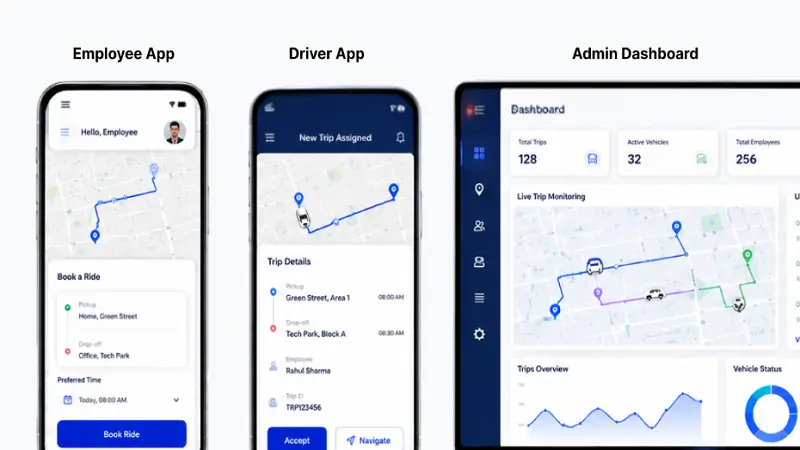
A strong employee transportation management system brings together tools for every user. Each feature plays a distinct role in daily operations.
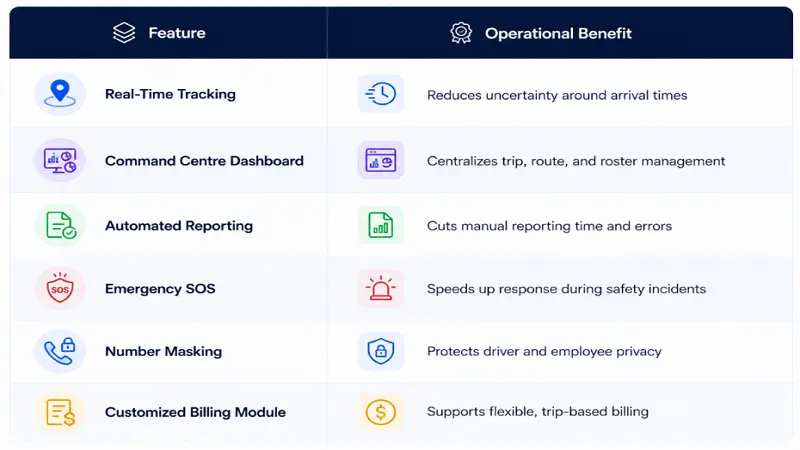
Real-Time Tracking and Route Management
A real-time vehicle tracking system shows live locations. Employees see accurate arrival times instantly. Managers adjust routes quickly during traffic delays. Scheduling tools let admins optimize trips daily.
Employee App Capabilities
The employee app puts commute control in workers’ hands. It removes the need for manual approvals.
- Native apps that provide access to all ride features
- Route and timing details for approved stops
- Self-rostering options for commute preferences
- Ad-hoc booking for unplanned ride requests
- Trip details showing driver and vehicle information
- QR code check-in to confirm boarding
Driver App Capabilities
The driver app simplifies trip management for drivers. It also improves communication with the transportation team.
- Assigned trip views for upcoming rides
- Pickup and drop-off details for each trip
- Availability controls to go online or offline
- Guided navigation for accurate pickups
- Earnings and performance tracking over time
- An emergency button for safety incidents
Admin Dashboard and Reporting
The admin dashboard acts as the command centre. It brings trip tracking and roster management into one screen. Reporting tools generate insights that help managers act fast.
How Workforce Mobility Improves With Smart Scheduling
Workforce mobility depends on smart planning. An employee transport management software platform brings structure to this process.
● Route and Schedule Optimization
Route tools analyze pickup points and traffic patterns. They build efficient trips automatically. Schedules adjust when shift timings change. This keeps commute times shorter and predictable.
● Quick Ride Booking and Self-Rostering
Employees no longer need to call administrators. Quick booking takes just a few taps. Self-rostering lets employees set recurring preferences. The system books rides automatically based on those preferences.
● Accessibility Compliance Across Devices
Accessibility compliance removes barriers for every employee. The interface works across different devices and screen sizes. This matters for companies with diverse and distributed workforces.
Operational Efficiency Gains for Transportation Managers
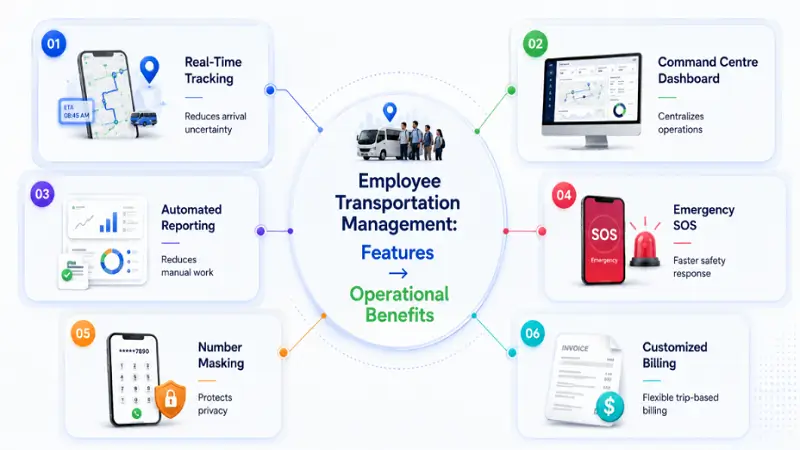
Transportation managers benefit directly from centralized control. An employee transportation management system replaces fragmented processes with one workflow.
● Centralized Command Centre
A command centre brings trip tracking into one dashboard. It also includes roster and route management. Managers no longer need separate tools or spreadsheets. This saves time and avoids scheduling conflicts.
● Automated Reporting and Analytics
Automated reports remove manual data compilation work. Managers review trip history and driver performance easily. These insights support better fleet and budget decisions.
● Emergency SOS and Safety Tools
Safety remains a top priority for transportation operations. Emergency SOS features alert authorities immediately during incidents. Safe drop confirmation adds another layer of verification.
The table below connects core features to specific benefits.
Employee Transport Management Software Versus Manual Coordination
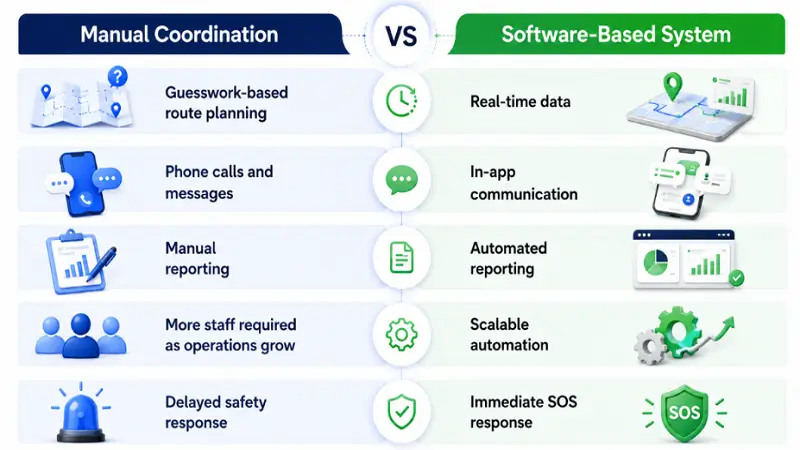
Comparing manual coordination with software shows a clear gap.
● Cost and Scalability Differences
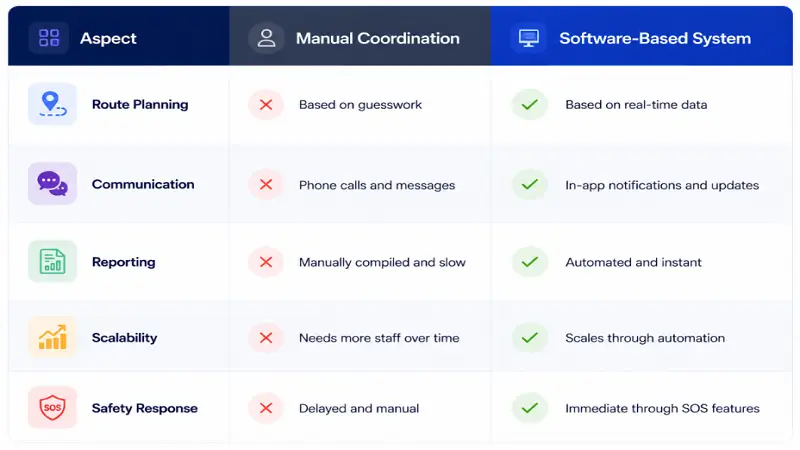
Manual coordination needs more staff as headcount grows. Costs rise due to inefficient routing decisions. An employee transport management solution scales with the organization. Route planning and billing adjust automatically as teams grow.
● Data-Driven Decision Making
Manual systems rely on guesswork and past experience. Software platforms collect trip and cost data continuously. Managers use this data to plan routes accurately. Better data leads to better budget decisions.
The table below outlines the key differences.
Real-World Examples of Employee Transportation Solutions
Real deployments show how employee transportation solutions solve practical problems.
● Airport and Airline Crew Logistics
A large airport and airline in Southeast Asia needed better crew transport. Manual scheduling could not keep pace with flight changes. A structured platform brought route optimization and live tracking. This improved punctuality and reduced coordination effort.
● Educational Institute Transportation
An educational institute needed reliable staff and student transport. Public routes did not match class or shift schedules. A dedicated platform introduced route planning and live tracking. This gave the institute better visibility and safety oversight.
Checklist Before Choosing an Employee Transport Management Solution
Use this checklist to evaluate platforms before deciding.
- Confirm support for real-time tracking and route adjustments
- Check for separate employee and driver apps
- Verify centralized scheduling and reporting in the dashboard
- Ensure emergency SOS and safe drop features are included
- Look for accessibility compliance across devices
- Ask about cloud and on-premise deployment options
- Review billing flexibility across different models
- Confirm dedicated implementation and support teams
- Check integration with existing HR or attendance systems
- Ask for audit-ready logs for compliance needs
Future Trends Shaping Employee Transportation Solutions
Workforce mobility technology keeps evolving with changing commute patterns.
● AI-Driven Route Prediction
Artificial intelligence increasingly supports route prediction. It uses historical traffic and booking data. Platforms suggest optimized routes before delays occur. Companies using these tools see fewer last-minute changes.
● Sustainability and Shared Mobility
Shared mobility options are gaining traction across companies. Shared vehicles help reduce per-employee transport costs. Consolidated routes also support emission reduction goals. This trend will shape future employee transportation solutions.
Conclusion
An employee transportation management system brings structure and safety to commutes. It replaces manual processes with connected apps. Companies gain better visibility into daily operations. Employees get a dependable and predictable commute experience.
Public transport reliability will vary across cities. But dedicated platforms give companies control over workforce mobility. Start by reviewing the checklist above. It is a practical first step toward the right employee transportation solution.